Money in Thailand 2026: Cash, Cards, ATMs and the Fees Worth Avoiding
Thailand runs on a strange mix: QR payments everywhere, yet immigration wants to see paper cash and the taxi to your hotel may take nothing else. Here's how to handle money as a visitor — how much cash to carry, what ATMs really charge, where cards work, and the exchange traps that quietly cost 5–10%.
Verified: October 28, 2026
One less thing to arrange
The cash you need before immigration
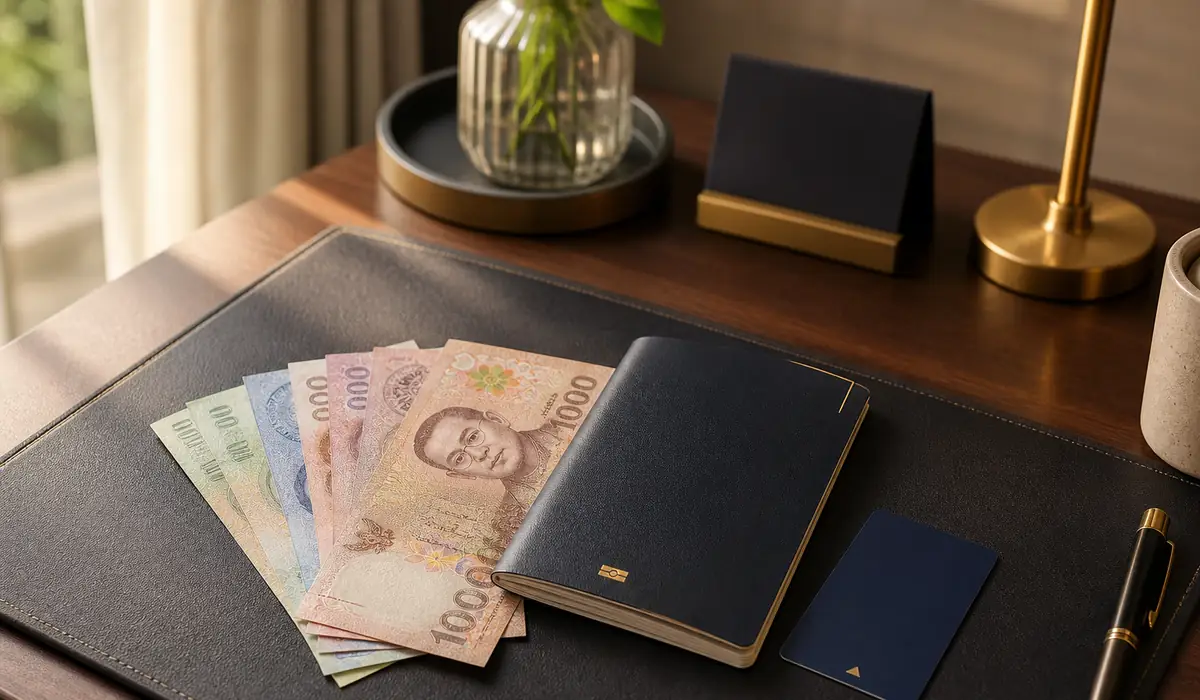
Start with the rule that surprises people: visa-exempt visitors can be asked at immigration to show 20,000 baht per person (40,000 per family) in cash or equivalent — before you've passed a single ATM you can rely on. Carry it from home in a major currency. It's not a fee; it's money you'll spend on the trip anyway.
ATMs: convenient, and priced accordingly
Thai ATMs charge foreign cards a fixed fee of roughly 220–250 baht per withdrawal on top of whatever your own bank adds. The counter-move is fewer, larger withdrawals — most machines dispense 20,000–30,000 baht per transaction. Always decline the ATM's own conversion offer ('with conversion' / DCC) and let your bank convert; the machine's rate is consistently worse.
Cards and QR payments
Visa and Mastercard work in hotels, malls, chain restaurants and supermarkets; street food, markets, songthaews and many island businesses remain cash-only. Thailand's own PromptPay QR codes are everywhere but generally need a Thai bank account — though tourist wallet apps and some foreign banking apps now bridge this. Plan on cash for anything under a few hundred baht.
Exchanging money without losing 8%
Best rates in Thailand: the orange SuperRich-style exchange booths in Bangkok and dedicated exchange counters in tourist cities — often better than you'll get at home. Worst rates: airport arrival-hall counters and hotel front desks. A sane pattern: change a small amount at the airport for the taxi, then the bulk in the city. Bring clean, newer-series banknotes; worn or old-series bills get refused.
Typical daily budgets, for planning
Street-food-and-hostel travel runs 1,000–1,500 baht/day; comfortable mid-range with hotels, restaurants and taxis 2,500–4,500; luxury is its own ceiling. Big-ticket items — diving courses, island transfers, tailored clothes — are often cash-discounted: asking 'cash price?' politely is normal and works.
Tipping and small-money etiquette
Tipping is appreciated, not obligatory: round up taxis, leave 20–50 baht for restaurant service where no service charge applies, 50–100 baht/day for hotel housekeeping, more for exceptional guides and spa staff. Keep small notes — a 1,000-baht bill for a 60-baht noodle bowl is a genuine problem at 7 a.m.
Leaving with baht
Taking more than 50,000 baht in Thai currency out of the country requires permission (the limit is 2,000,000 baht when you travel to Cambodia, Laos, Malaysia, Myanmar, Vietnam or Yunnan in China). You must declare cash when you enter or leave with more than 450,000 baht in Thai currency, more than US$15,000 in foreign currency, or both together worth more than 450,000 baht. Practically: spend down your baht or change it back before the gate — the airside exchange rate is the worst of your whole trip.
What each way of getting baht actually costs
The differences here are worth real money over a two-week trip, and they are not obvious.
| Method | Typical cost | Best used for |
|---|---|---|
| Exchange booth in the city | Close to the mid-market rate | The bulk of your spending money |
| Airport exchange booth | 3 to 5 per cent worse | The first taxi and the first meal, nothing more |
| Thai ATM | 220 to 250 baht per withdrawal, plus your bank's fees | Topping up, in as few withdrawals as possible |
| Exchanging at home before you fly | Usually poor for baht | Only if you want the immigration cash ready |
| Card at the till | Your bank's foreign transaction fee, if any | Hotels, malls, restaurants |
| Paying in your own currency at a Thai card machine | 4 to 8 per cent, invisibly | Never |
That last row is the one that costs the most and is noticed the least. It has a name.
Dynamic currency conversion, and how to refuse it
When a Thai card machine offers to charge you in pounds, euros or dollars instead of baht, it is offering to do the conversion itself, at a rate it chooses. The markup is typically 4 to 8 per cent and it is presented as a convenience.
Always choose baht. Let your own bank do the conversion — it will almost always be closer to the real rate.
The same offer appears at ATMs: the machine asks whether you accept its conversion, and declining sounds risky. It is not. Decline, and the withdrawal completes at your bank's rate.
Fewer, larger withdrawals
The 220-to-250-baht ATM fee is fixed per withdrawal, not proportional. Which makes the arithmetic stark:
| How you withdraw 20,000 baht | Fees |
|---|---|
| One withdrawal of 20,000 | About 220 to 250 baht |
| Four withdrawals of 5,000 | About 880 to 1,000 baht |
Most machines dispense 20,000 to 30,000 baht in one go, depending on the bank, though your own bank may cap you lower. Some travel-focused accounts refund foreign ATM fees; if yours does, this whole section stops applying.
Safety consideration worth balancing against it: carry what you need for a few days, not for the whole trip, and use the hotel safe for the rest.
What is cash-only, in practice
The line falls in a predictable place, and knowing it prevents standing at a street stall with only a card.
Cards work: hotels, shopping malls, chain restaurants and cafés, supermarkets, 7-Eleven, department stores, airline and tour desks, hospitals.
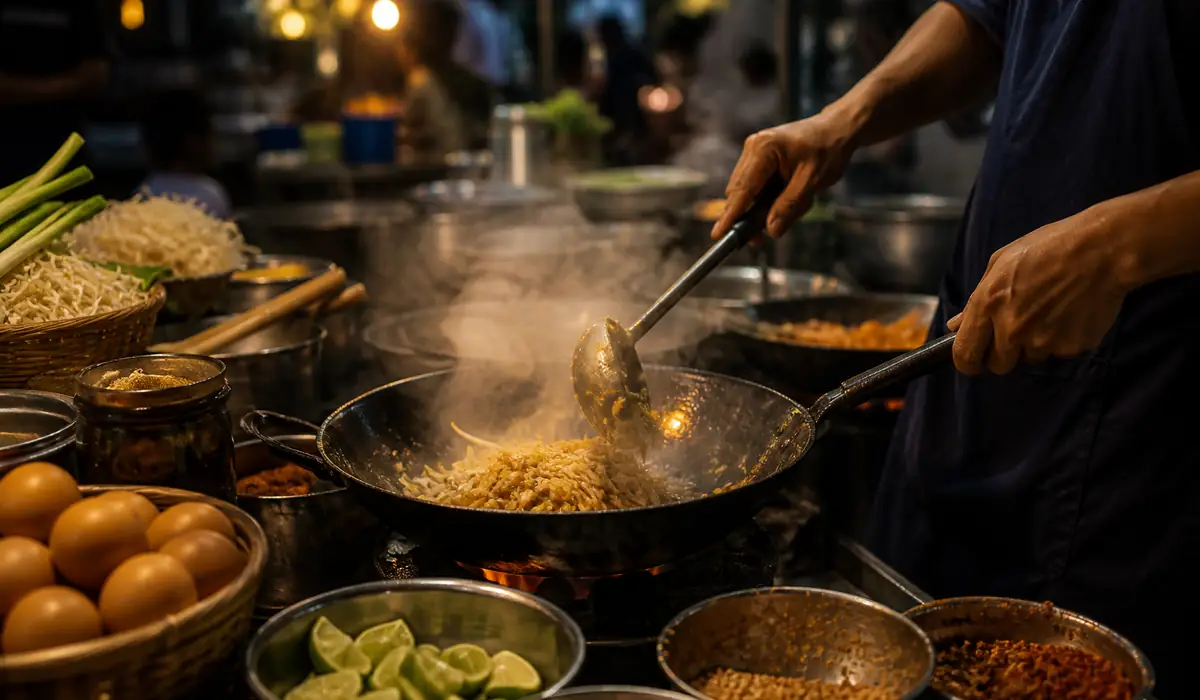
Cash only: street food, markets, songthaews and local buses, most massage shops, small guesthouses, motorbike rental, temple donations, island beach bars, many taxis in practice even when a machine exists.
QR (PromptPay): ubiquitous among Thai residents, but it generally needs a Thai bank account, so it is not usually available to a visitor. Some tourist-facing businesses accept international QR wallets — treat it as a bonus, never as the plan.
The practical rule: carry small notes. Breaking a 1,000-baht note at a street stall is a daily inconvenience; ATMs love dispensing them and vendors do not love receiving them.
A budget you can actually plan against
| Style | Per person, per day | What that buys |
|---|---|---|
| Backpacker | 1,000 to 1,500 baht | Hostel, street food, local transport |
| Comfortable | 2,500 to 4,500 baht | Mid-range hotel, restaurants, taxis, a paid activity |
| Upmarket | 6,000 baht and up | Its own ceiling |
Budget separately for the things that break the daily average: a diving course, an island transfer, a Grand Palace ticket, a domestic flight. Those are trip-level costs, not daily ones, and they are what turns a carefully planned budget into a surprise.
Money at each end of the trip
Arriving. Have baht or a major currency in cash for the funds check, and enough baht for a taxi and a meal. Change the rest in the city.
Leaving. Spend or change your baht before departure. Rates for selling baht back at foreign airports are poor, and there is a legal limit anyway: taking more than 50,000 baht in Thai currency out of the country requires permission, with a higher limit for some neighbouring countries. You must declare more than 450,000 baht in Thai currency, or more than US$15,000 in foreign currency, when you enter or leave.
In between. Keep the immigration cash separate from your spending money for the first day or two. Travellers who arrive with exactly the funds threshold and immediately spend it are fine — the check happens once, at entry — but it is worth knowing that is the sequence rather than discovering it.
The immigration cash check has its own rules — read the 20,000 baht proof of funds guide so the first desk in Thailand goes smoothly.
Sources checked
- Civil Aviation Authority of Thailand: AIP GEN 1.3, customs and currency rules · October 28, 2026
- Royal Thai Embassy, Brussels: visa exemption conditions · October 28, 2026
- Tourism Authority of Thailand: proof of funds for foreign visitors · October 28, 2026